As search behavior shifts from simple keyword queries to direct conversation with artificial intelligence, staying visible online requires far more than traditional search ranking.
For decades, digital marketing relied on a straightforward formula: target keywords, build backlinks, and rank on page one of Google. Today, platforms like ChatGPT, Perplexity, and AI Overviews are changing how users seek information. Users no longer just type a query and click a link; they ask complex questions and expect complete, synthesized answers in real time.
To remain competitive, brands must navigate three distinct pillars of digital visibility: SEO, GEO, and AEO.
What’s the one-sentence difference between them?
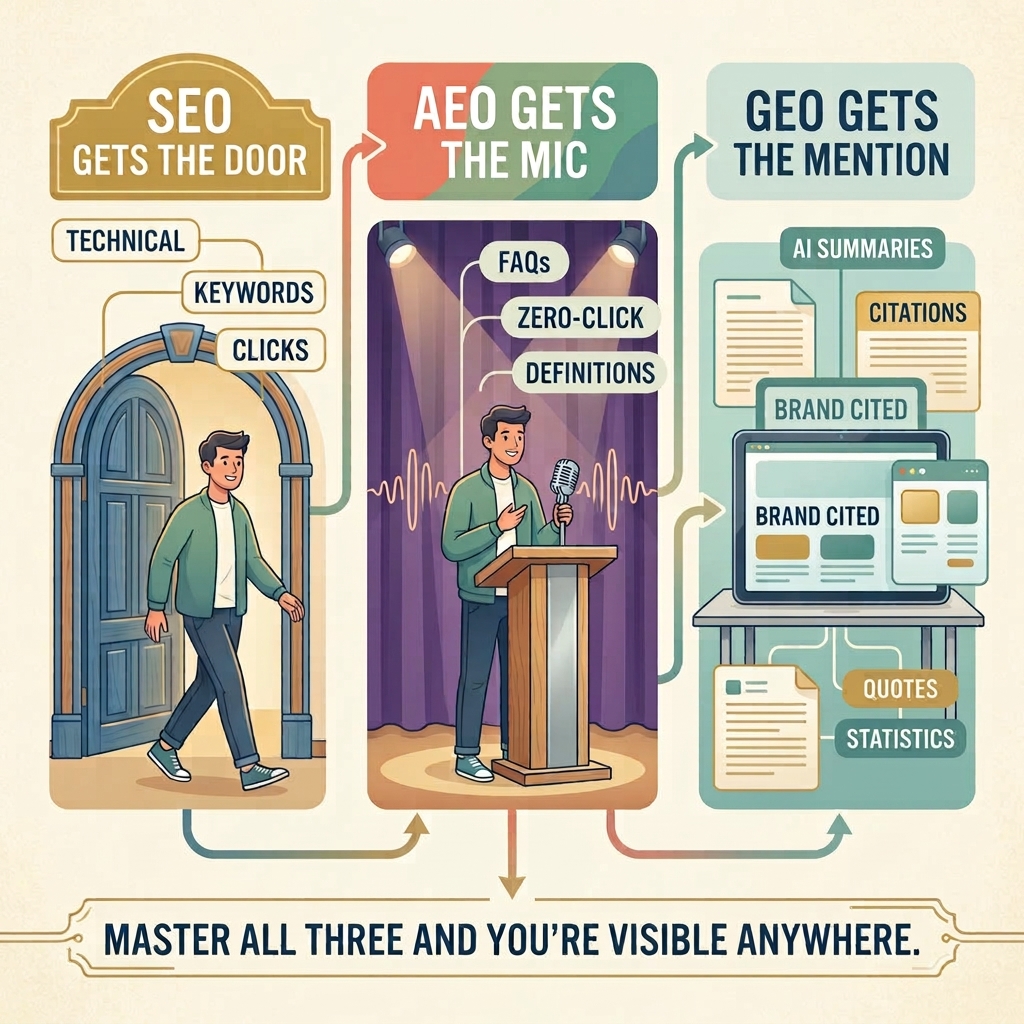
- SEO gets you found in ranked search results (Google, Bing).
- AEO gets you quoted as a direct answer (featured snippets, voice assistants, AI Overviews).
- GEO gets you cited or recommended inside AI-generated answers (ChatGPT, Perplexity, Claude, Gemini).
A common shorthand: SEO wins you the right to be in the running, AEO wins the citation, GEO wins the sentence.
What does SEO actually involve?
Traditional SEO is about ranking well in classic search-engine results pages. It relies on things like keyword targeting, backlinks, site speed, technical crawlability, and domain authority. It’s the foundation the other two build on — AEO and GEO still depend on many of the same trust and relevance signals SEO has always optimized for.
What does AEO actually involve?
AEO focuses on making content easy for an engine to lift out and present as a single, direct answer — think Google’s featured snippets, “Position Zero,” voice assistant replies, or AI Overviews. It rewards content that’s structured for extraction: clear headings, concise Q&A formatting, bullet points, and tight, unambiguous answers near the top of a page.
What does GEO actually involve?
GEO focuses on getting cited or referenced by generative AI models when they synthesize a longer answer from multiple sources — for example, when ChatGPT or Perplexity writes a paragraph comparing products and mentions your brand by name. Where AEO wants short, extractable answers, GEO rewards depth: long-form content with nuance, edge cases, comparisons, and evidence that a model can draw on while writing something new (rather than just copying a snippet).
Comparing the Three Strategies
| Feature | SEO (Search Engine Optimization) | GEO (Generative Engine Optimization) | AEO (Answer Engine Optimization) |
| Output Type | List of ranked links (SERPs) | AI-synthesized summary with citations | Single direct answer or featured snippet |
| Primary Platforms | Google, Bing, Yahoo | ChatGPT, Perplexity, AI Overviews | Voice Assistants, Featured Snippets, Smart Speakers |
| Core Optimization | Keywords, backlinks, technical site structure | Quotes, statistical data, domain authority | FAQ schema, clear definitions, structured formats |
| Conversion Metric | Click-Through Rate (CTR) & Web Traffic | Brand Citations & Information Share | Zero-Click Authority & Direct Engagement |
Does GEO replace SEO?
No. Most sources agree GEO and AEO enhance rather than replace SEO — generative engines still lean on many of the same authority and relevance signals traditional search algorithms use (backlinks, credibility, structured data, freshness). The three are best treated as complementary layers rather than competing strategies.
How should I think about all three together?
A useful mental model is a three-layer stack:
- SEO establishes baseline visibility and credibility across traditional search.
- AEO makes sure your content can be lifted directly as an answer.
- GEO positions your content as trustworthy reference material that AI models cite or recommend when generating a response.
What content tactics help with AEO specifically?
- Lead with a clear, concise answer near the top of the page
- Use question-based headings that mirror how people actually ask things
- Format key facts as short lists or tables
- Add structured data / schema markup where relevant
- Keep answers self-contained (don’t require reading the whole page for the gist)
What content tactics help with GEO specifically?
- Cover a topic in real depth — comparisons, edge cases, pricing, trade-offs
- Back claims with data, sources, or original research a model can point to
- Build genuine third-party authority (mentions, citations, reviews elsewhere) — GEO is heavily influenced by signals outside your own site
- Keep information accurate and current, since generative engines weigh trustworthiness heavily
How do you measure success in each discipline?
- SEO: rankings, organic traffic, click-through rate
- AEO: snippet/featured-answer placements, voice search appearances, “Position Zero” wins
- GEO: citation frequency and sentiment in AI-generated responses (harder to track directly, since there’s less standardized analytics tooling here so far)
In short: the goal isn’t to pick a discipline — it’s to make your content findable, quotable, and trustworthy enough that any engine, human or AI, wants to surface it. Master all three, and you’re visible no matter how someone searches.